
Dot Drama: Binge Short Stories
Agile TeamsEntertainment
4.5411.00 Reviews
- Version
- 2.7.0
- Installs
- 10.00M
- Age Rating
- Teen
Screenshots
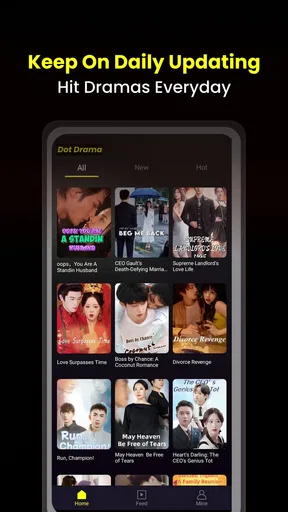


Our Review of Dot Drama: Binge Short Stories
 Analysis by Appyee
I tried Dot Drama: Binge Short Stories as the kind of entertainment app you open when you have a few spare minutes and want a quick emotional hook rather than a long film or a full novel. Its focus is easy to understand: compact stories built around romance, tension, revenge, and clashes between wealthy or powerful characters. I found it most appealing when I wanted something dramatic enough to hold my attention immediately, but light enough to pick up and leave without planning a whole evening around it.
That short-session design also makes it interesting on a shared phone or tablet. Someone in the household can read a story while waiting for dinner, then hand the device to another person without committing to a lengthy viewing session. At the same time, the app is not a neutral family entertainment library. The Teen content rating matters, because the emotional themes and relationship conflicts are aimed at older children and adults rather than very young users. My overall impression is that it works best when everyone using the device understands what sort of dramatic material it contains.
How Dot Drama fits into everyday shared use
The most realistic use case for me was a short break after work. Instead of opening a streaming service and spending several minutes choosing a show, I could go straight into a compact story and get to the central conflict quickly. That immediacy is the main reason I would recommend it to a friend who likes dramatic fiction but often abandons longer entertainment before it gets going.
On a shared device, the same quality can be convenient and slightly awkward. A partner might enjoy the romance-focused stories, while another household member may prefer revenge plots or power struggles. Because the app is built around quick, attention-grabbing fiction, it is easy for different people to use it at different times. However, I would not treat it like a general-purpose app that is automatically suitable for every person who picks up the tablet.
The app comes from Agile Teams and is listed in the entertainment category. It is free to install, which lowers the barrier for trying it together, but optional purchases range from under a dollar to around thirty dollars per item. That makes a simple household rule useful: decide in advance whether the app is for free reading only, or whether purchases are acceptable and who should approve them. The distinction is important because “free” describes access to the app, not necessarily every possible item inside it.
I also noticed that short-form drama changes how people share recommendations. With a traditional series, I might tell someone to watch an entire episode. Here, I would be more likely to point out a particular storyline or suggest the app for a specific mood: romantic tension when someone wants something emotional, or revenge-driven conflict when they want a faster, more intense read. That makes informal coordination easier, although it also means two people can have very different impressions depending on which stories they encounter first.
What to settle before putting it on a shared device
The first boundary I would establish is whether the device belongs to one person or is genuinely communal. If it is a personal phone, the owner can decide how much of the app to use and whether purchases are worthwhile. If it is a family tablet, I would explain that the app is intended for Teen audiences and agree on when it can be used. I would not rely on the fact that a story looks like a simple mobile read; the themes are still relationship-centered and can involve emotionally heavy conflict.
The second boundary concerns spending. I would avoid handing the device to a child or guest with the assumption that a free app cannot create paid decisions. The available purchase range is broad enough that a casual tap could have a very different consequence from unlocking a small extra item. I would therefore keep payment decisions with the device owner and ask other users to mention which story or item they want rather than making the purchase themselves.
A third practical boundary is time. Short stories are easy to start because they appear manageable, but a sequence of dramatic episodes can turn a five-minute break into a much longer session. In my experience, the best way to keep the app from taking over a shared evening is to use it as a defined activity: one person reads during a break, then gives the device back, instead of leaving it open as background entertainment for everyone.
These boundaries are not special controls that I would claim the app provides. They are household habits. That distinction matters. I would not choose this app expecting a complete family-management system, separate child profiles, or a built-in way to coordinate every person’s access. If those functions are essential, the device’s own account and purchase settings should do the heavy lifting, while the app remains the content source.
Keeping stories and spending from getting mixed up
Shared use becomes smoother when people communicate before they begin. I would suggest telling other users whether you are reading for romance, revenge, or simply a quick dramatic distraction. That sounds obvious, but it prevents a common annoyance: one person opens the app expecting a light relationship story and instead finds a more aggressive power struggle that another user had been following.
I would also keep recommendations specific. Rather than saying “this app is good,” I would say, “try it if you want a short story with immediate romantic tension,” or, “skip it tonight if you want calm, realistic fiction.” The app’s appeal depends heavily on mood. Its store summary points toward sweetness, angst, romance, revenge, and clashes involving wealth or power, so it is not trying to serve every literary taste. A precise recommendation is more useful than broad praise.
For purchases, I would use a simple approval conversation: identify the item, confirm who wants it, and decide whether it is worth paying for before selecting anything. This is especially helpful when several people use one account or one device, because an accidental purchase can become a household disagreement even when the amount seems small. I would not assume that every user understands the difference between free access and optional paid content.
Another useful habit is to avoid treating another person’s reading position as communal property. If one household member is following a story, someone else should not jump ahead merely because the device is available. The app is built for bingeable short fiction, and that makes spoilers easy to create. A quick message such as “I am still reading that one” can prevent the shared-device experience from becoming frustrating.
This is also where the app differs from ordinary video streaming. A streaming service usually makes it obvious which profile is watching and where playback stopped. With a short-story app, the boundary between one person’s activity and another’s can feel less formal. I found that verbal coordination is more important than it would be with a television app, particularly when several people use the same screen and enjoy the same genre.
Age context and the question of trust
The Teen rating should guide the household conversation, not be treated as a decorative label. I would be comfortable recommending the app to a teenager who already enjoys dramatic romance and understands that the stories may focus on betrayal, revenge, intense relationships, and status conflicts. I would be more cautious with a younger child, not because every story is necessarily unsuitable in the same way, but because the app’s overall direction is clearly not designed around children’s entertainment.
For parents, the most useful approach is to discuss the themes rather than promise that every story will feel identical. A teenager may be interested in the romantic plots but dislike harsher revenge narratives, or enjoy the wealthy-power setting while finding the relationship drama excessive. I would encourage a young user to speak up if a story feels uncomfortable instead of assuming that a Teen label answers every personal question about suitability.
Trust also matters because this is an entertainment app rather than a shared family noticeboard. I would not use it as a way to supervise what another household member reads. If a parent needs clear oversight, the better solution is an honest agreement about device use and the operating system’s account arrangements, not an assumption that the app itself will provide all the necessary separation.
That is particularly important when a family shares one account. Reading habits, recommendations, and purchase decisions can become confusing when they are all attached to the same access point. Even without inventing any account feature, the practical lesson is clear: separate device users as much as the platform allows, and do not treat a communal login as private. If a household cannot agree on those boundaries, I would hesitate to install the app on the shared device.
Adults should also remember that the app’s dramatic style can make fictional behavior look more glamorous or extreme than it would in ordinary life. Stories involving money, status, revenge, and romantic conflict are designed to create strong reactions. I enjoyed that heightened tone as escapism, but I would not recommend presenting it to a young user as a realistic guide to relationships or decision-making.
What the current version does well for short sessions
The current version is 2.3.0, and the basic appeal remains the speed with which it gets to a story’s emotional premise. I did not need a large block of uninterrupted time to enjoy it. That makes the app a good companion for commutes, waiting rooms, lunch breaks, or the quiet few minutes before bed, provided the user is comfortable with the Teen-oriented themes.
Its strongest quality is not depth in the traditional novelistic sense. It is momentum. The stories are designed to make the next moment feel important, which suits readers who like reversals, secrets, romantic uncertainty, and confrontations between characters with very different levels of influence. If you prefer slow world-building, subtle dialogue, or a long period of calm before the conflict begins, this may feel too eager to create drama.
I also like the way the format lowers the commitment required to try a new storyline. With a printed novel, an unappealing premise can mean carrying the book around for days before deciding to stop. With this app, I can test the tone quickly and move on if the combination of romance and revenge is not working for me. That flexibility is especially helpful on a shared device, where different users can sample the app without taking over the evening.
There is a trade-off, though. The same immediacy that makes the app accessible can make the experience feel repetitive if every storyline relies on equally sharp betrayals or dramatic status clashes. I would use it when I want heightened fiction, not as my only source of reading. Alternating it with a conventional ebook, a podcast, or a carefully chosen television series gives the more intense material room to stay enjoyable.
The app has attracted an average rating of 4.7 from around 78 thousand ratings, and it has passed 10 million installs. Those figures suggest that the short-drama format has found a substantial audience, but they do not remove the need to judge whether its particular tone suits you. Popularity is a useful signal that the concept works for many people; it is not proof that someone who dislikes melodramatic romance will suddenly enjoy it.
Where it beats familiar entertainment alternatives
Compared with a standard streaming service, this app is faster to enter and easier to use in a silent environment. I can read without needing headphones, wait through a video introduction, or reserve a large screen. That makes it better for a shared household where one person is watching television and another wants private entertainment on a phone.
Compared with social media, it offers a more focused kind of escape. Social feeds may provide endless variety, but they also bring notifications, unrelated arguments, and unpredictable distractions. Dot Drama keeps the attention on fictional conflict. For me, that made a short break feel more deliberate, although the bingeable structure can still encourage longer use than planned.
Compared with a full ebook app, it is easier for readers who want immediate stakes and compact installments. A conventional ebook is the better choice when I want literary detail, a slower relationship arc, or the freedom to choose from many unrelated genres. This app is narrower but more decisive: it knows that its audience is coming for emotional turns, romance, revenge, and power dynamics.
Compared with interactive story games, it is also a different kind of experience. I would not install it expecting branching choices, strategic play, or the feeling that my decisions reshape the plot. Its attraction is the act of following dramatic fiction rather than controlling a game system. Someone looking for agency should choose an interactive alternative instead; someone who wants to relax and let the story carry them may prefer this format.
One non-obvious advantage is that the app can work as a conversation starter in a household without requiring everyone to consume the same long program. One person can mention a surprising twist or a character’s decision, and another can decide whether that style sounds appealing. The downside is that spoilers become a real coordination issue, so shared users should agree on whether discussing a story is welcome before revealing its turns.
Who should install it, and who should pass
I would recommend it to readers who enjoy compact romantic drama, heightened emotional conflict, and stories where revenge or social power creates immediate pressure. It is also a good fit for someone who repeatedly says they want to read more but rarely has time for a long book. The short-form approach reduces the effort needed to begin, and the free entry point makes sampling less intimidating.
I would be more careful recommending it to someone who wants factual entertainment, educational material, comedy without relationship conflict, or a broad library of unrelated genres. The app’s identity is specific. Its focus on sweet and angsty romance, revenge, and rich-versus-powerful clashes is a strength when that is exactly what you want, but it becomes a limitation when your mood calls for something quieter or more varied.
I would also skip it for a shared family tablet if the adults cannot agree on Teen-appropriate use or purchase responsibility. The app can fit into a household, but it does not remove the need for household rules. A personal device is simpler because one person can control the reading context and spending decisions without negotiating every session.
For teenagers, I would frame it as fictional entertainment rather than a substitute for guidance about relationships. For adults, I would set a spending limit before exploring optional items. For couples or roommates, I would recommend keeping separate reading expectations and warning each other about spoilers. These small decisions make a bigger difference than any enthusiastic description of the story themes.
My household verdict after using it
My final view is positive, with clear conditions. Dot Drama is an entertaining choice when I want quick, emotionally charged fiction and do not want to commit to a film, a long series, or a full-length novel. Agile Teams has aimed at a very recognizable audience, and the app’s combination of romance, angst, revenge, and power-driven conflict gives it a distinct personality rather than making it a generic reading tool.
For shared use, I would install it only after agreeing on three things: who may use the device, whether Teen-oriented stories are appropriate for those users, and who approves optional purchases. I would also keep recommendations and reading progress personal where possible, because a communal device can easily turn a private story into a source of spoilers or confusion.
The free price makes trying it straightforward, while the optional items mean that adults should not confuse free installation with unlimited cost-free use. The large existing audience and strong average rating make it reasonable to sample, but my recommendation still depends on taste. If you enjoy dramatic romance and quick reversals, it is easy to see why the app has attracted attention. If you want calm, realistic, or highly interactive entertainment, another category will serve you better.
My recommendation: use it as a deliberately chosen short-drama break, not as an automatic family app. On a personal phone, it is a convenient way to binge compact stories whenever the mood strikes. On a household device, it can work well when age expectations, account boundaries, spending, and spoilers are discussed first. That balance is what makes the experience enjoyable instead of needlessly complicated.
Privacy and Permissions
See what permissions an app requests and how it handles your data.
- Phone
- read phone status and identity
- Wi-Fi connection information
- view Wi-Fi connections
- Device ID & call information
- read phone status and identity
- Other
- view network connections, connect and disconnect from Wi-Fi, full network access, control vibration, prevent device from sleeping, Google Play license check, read Google service configuration
Verdict
Strengths of Dot Drama: Binge Short Stories
- Short episodes make it easy to watch during quick breaks.
- Romance, drama, and suspense stories offer plenty of variety.
- Vertical video format feels natural on a phone.
- New story chapters can provide a steady stream of content.
- Simple controls make browsing and starting episodes effortless.
Limitations of Dot Drama: Binge Short Stories
- Frequent cliffhangers may require watching many episodes to finish a story.
- Some content may feel repetitive if you prefer longer, complex plots.
- Video streaming can use significant mobile data without Wi-Fi.
- Availability of stories and features may vary by region or device.
- The app may not appeal to viewers who dislike melodramatic storytelling.
Similar Picks in This Category
View All
Google Play Games
Google LLC3.9

Netflix
Netflix, Inc.4.8

YouTube Kids
Google LLC4.2

Disney+
Disney4.4

Prime Video
Amazon Mobile LLC4.7

Steam
Valve Corporation3.2
Frequently Asked Questions
What is Dot Drama: Binge Short Stories?
Dot Drama: Binge Short Stories is a mobile entertainment app built around short, fast-paced fictional episodes. It is designed for viewers who enjoy dramatic storylines, romance, suspense, and cliffhangers but do not want to commit to a full-length television series. Stories are divided into brief chapters, making them convenient to watch during short breaks or while traveling.
Is Dot Drama: Binge Short Stories free to download and use?
The app can generally be downloaded without an upfront purchase, but access to all content may depend on the platform’s current monetization system. Some episodes or features may be available for free, while premium chapters, early access, subscriptions, or in-app purchases can be offered. Before watching extensively, check the in-app pricing, trial terms, and renewal conditions shown on your device.
Does Dot Drama: Binge Short Stories require an internet connection?
An internet connection is normally required to browse the catalog, load video content, synchronize your account, and access newly released episodes. Depending on the version of the app, selected content may or may not support offline viewing. Users with limited mobile data should watch over Wi-Fi when possible, because frequent short-video playback can still consume a considerable amount of data.
Is Dot Drama: Binge Short Stories suitable for children?
Parents should review the app’s age rating and individual story descriptions before allowing children to use it. Short dramas may include themes such as relationship conflict, emotional manipulation, violence, mature dialogue, or suggestive situations, depending on the available catalog. The app may also include advertising or in-app purchases, so parental controls and purchase restrictions are recommended for younger users.
What should I check before subscribing to Dot Drama: Binge Short Stories?
Before starting a subscription, carefully review what it includes, such as premium episode access, ad removal, viewing limits, or early releases. Confirm the price, billing frequency, free-trial duration, and cancellation process through your Google Play or App Store account. Remember that deleting the app usually does not cancel an active subscription; cancellation must be completed through the relevant store settings.
